Craft
Inside The Cut Room
A look at how our hoodies are patterned, cut and finished — one panel at a time.
Studio Notes · 7 min read · 28 May 2026
A look at how our hoodies are patterned, cut and finished — one panel at a time.
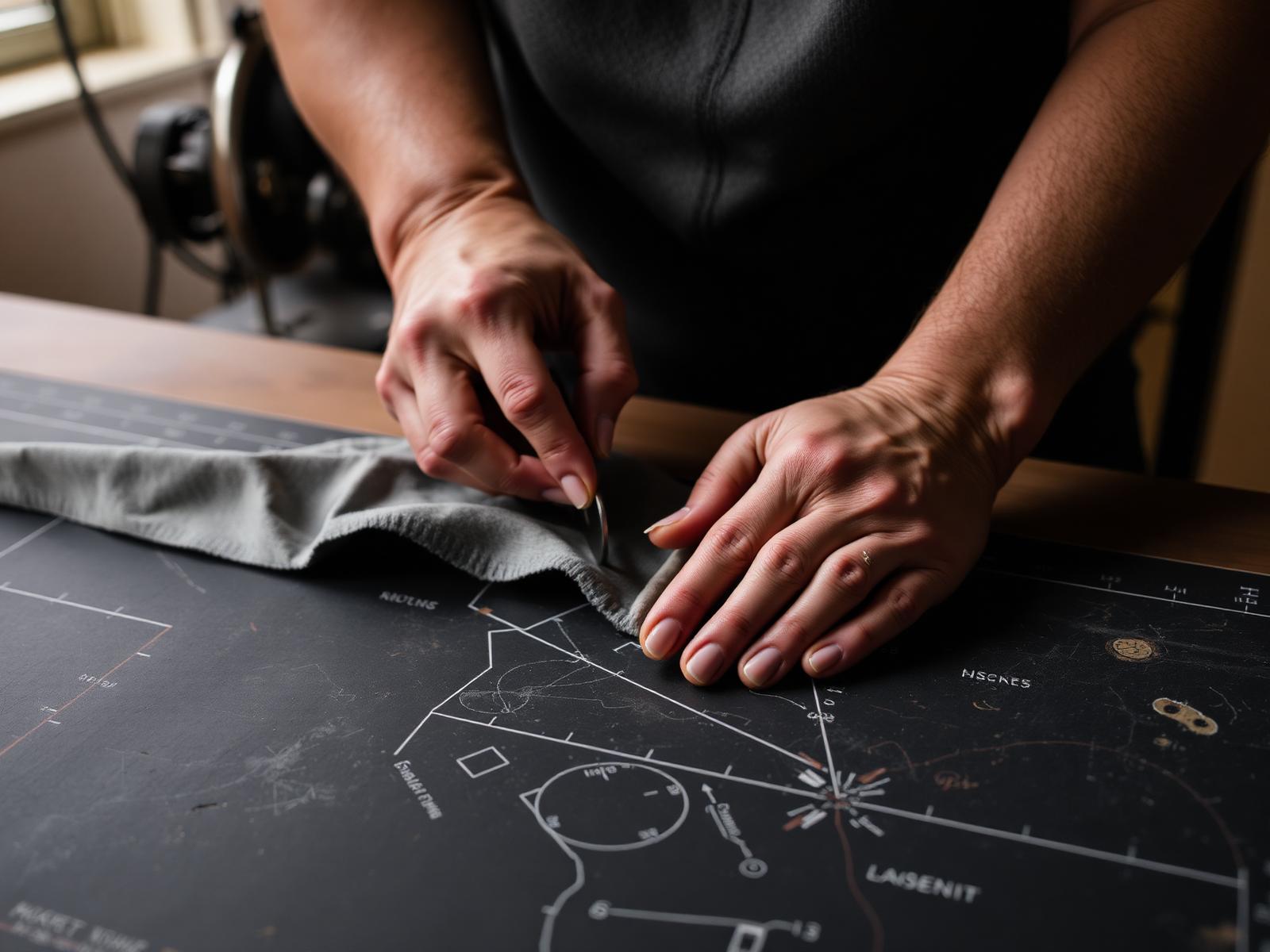
There's a romance to the cut room that no factory floor video really catches. The smell of unwashed cotton. The hum of an old Juki under a fluorescent tube. Chalk lines on dark fabric, pattern paper held down with metal weights, and the slow, careful pull of a rotary cutter against a steel rule.
Every Kushems hoodie passes through a person before it passes through a printer. That sentence sounds obvious until you visit the kind of factory most fast fashion brands use, where the cutting is automated, the stitching is timed in seconds, and a garment is on a container ship before anyone has worn it through a full day.
A piece starts as a flat sketch on A3. Sleeves first, body second, hood last — that's the order our designer works in, and it's the order we sample in too. The first sample is always wrong. We expect it to be. We make it specifically so we can see what's wrong with it.
Second sample is closer. The shoulder drop comes in. The hood gets a little deeper. The cuff length adjusts by two centimetres. We wear-test it for a fortnight — the studio crew, the warehouse crew, anyone we can put it on. We're looking for the moments it pulls in the wrong place, the way it sits after a wash, the bits that bother you only on the second wear.
The third sample is the piece you'll actually wear. By then every measurement on the spec sheet has been earned. Nothing on the sheet is arbitrary.
"We make it three times before we make it once."
When the pattern is signed off, we cut in stacks no taller than a thumb. Most factories stack fabric the height of a hand because it's faster — but the bottom layers always come out slightly off because the blade flexes through the depth. Shorter stacks mean every panel sits true.
It's slower. It costs us per garment. It's also why our pieces sit the way they do on the body. Garment fit is mostly a cutting problem, not a stitching problem — but most brands don't want to talk about it, because the fix is paying a cutter properly and giving them time.
Anyone can stitch a hoodie. The bar is set in the finish — the parts you only notice on the third wear, when you've already decided whether the piece is staying in rotation or quietly migrating to the back of the wardrobe.
We get asked, regularly, why we don't just outsource the harder parts and triple our output. The honest answer is that we don't think the brand would survive it. The minute we stop wearing the samples ourselves, the minute the cutting moves further than a phone call away, the minute we let the spec sheet drift — we become every other brand we started Kushems to react against.
Slow is the strategy. It's also, eventually, the moat.